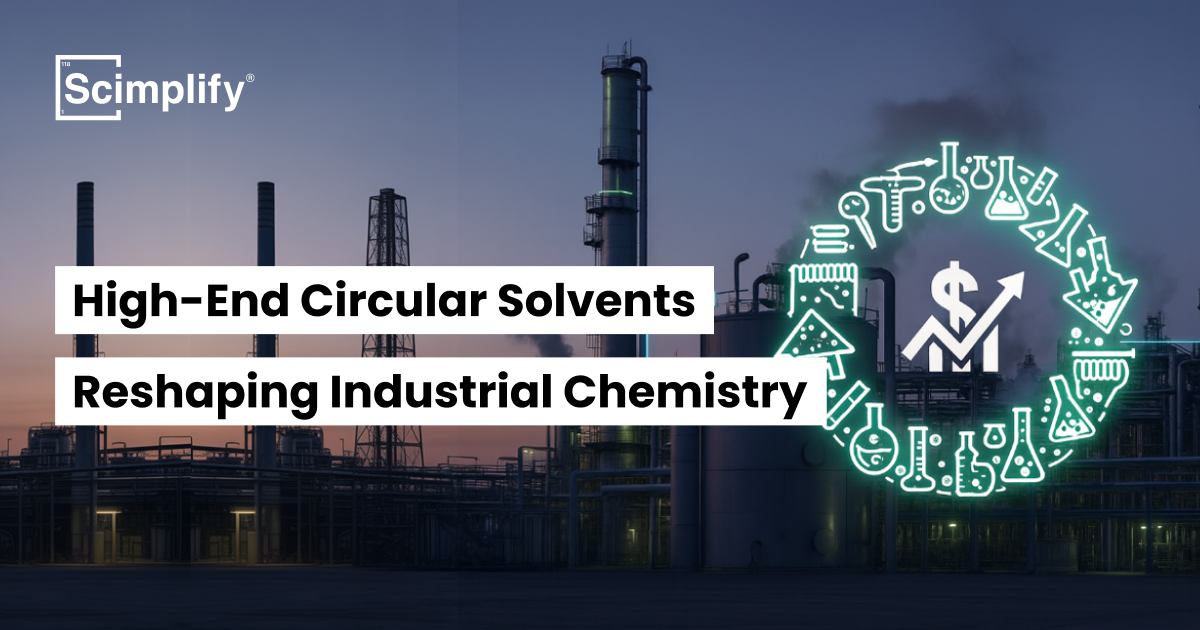
High-End Circular Solvents - Reshaping Industrial Chemistry
Circular solvents are reshaping industrial chemistry with lower emissions, cost savings, and advanced recovery technologies. Explore the $1.4B market shift and Scimplify’s role.
Stop for a second and look around you. That smartphone in your hand? The paint on your walls? The supplements you take? Every single one of these products shares something common: they all require special industrial chemicals called solvents to manufacture.
But here's a shocking truth: after using these expensive chemicals just once in manufacturing, 90% of solvents are simply incinerated, according to the EPA. This results in massive CO₂ dumping in our environment. We're talking about a potential $50 billion global market here, meaning literally billions of dollars' worth of chemicals going up in smoke.
Recently, though, scientists and engineers have figured out that recycling these solvents can cut greenhouse gas emissions by up to 90% when compared to making new ones from scratch. Think about that for a moment. We've been throwing away something valuable that we could easily reuse, all while damaging the environment and wasting money. This realization is creating an entirely new market called "circular solvents."
Understanding the Problem - Why We Waste So Much?
To truly grasp the opportunity here, let’s understand just how wasteful some of the current manufacturing practices are. Pharmaceutical companies, for instance, are some of the most solvent-intensive sectors in the world. In fact, creating just one ton of the active ingredients (APIs) generally releases between 50-100 tons of chemical waste.
Why does this matter financially? In doing so, companies face three separate costs. Firstly, they buy expensive virgin solvents at a premium price. Then they’ll have to pay substantial amounts to dispose of the used solvents as hazardous wastes. And then again, they'll end up paying carbon taxes or fees for the pollution that the waste disposal creates.
On average, each ton of solvent creates 2.5 tons of CO₂ emissions. As governments worldwide have started charging companies for carbon emissions, this becomes a massive and growing expense that just keeps growing every year onwards. For a large chemical manufacturer spending tens of millions annually on solvents, these combined costs represent a massive drain on profitability.
What Makes High-End Circular Solvents Different?
Here's the question everyone asks: "If recycling solvents is so obvious and beneficial, why haven't we been doing it all along?" The answer reveals why we're seeing this boom now rather than decades ago.
For a long time, recycled solvents were considered inferior. Good enough for low-specific applications like cleaning, maybe, but not for demanding applications like pharmaceutical synthesis or semiconductor manufacturing. It's like the difference between filtered tap water and medical-grade distilled water. They're both water, but they're never interchangeable.
But here's what changed everything: modern advanced purification techniques like membrane technology, multi-stage distillation, and AI-optimized separations can now make recycled solvents a lot more purer, in some cases even closer to the actual solvents. This isn't just a marketing spin; it's a measurable reality today. The recycling process actually removes impurities that might have been in the virgin solvent to begin with.
The Market Reality in Numbers
The circular solvents market reached $863.73 million in 2024 and is projected to hit $1.41 billion by 2034, growing at a 5% CAGR. In other words, we're looking at a market that will nearly double in size over the next decade. All thanks to the massive and global drive of environmental awareness, technological boom, and increasingly stricter regulatory pressures.
Not only that, governments around the world are pushing circular-economy practices predominantly in the chemicals sector. In Europe, the transformation is most aggressive, with the EU's Critical Raw Materials Act mandating that over 25% of raw materials come from recycled sources by 2030.
In the United States, while the whole country’s trajectory is moving rather slowly, individual states are jumping on the wagon sooner. For instance, the state of Oregon has implemented an Extended Producer Responsibility (EPR) system, which inherently rewards companies that use recyclable and circular materials, while increasing cost and accountability for those dependent on waste-intensive, non-recyclable solvent systems.
Wondering how recycling can actually exceed virgin-quality standards? The recycling process itself serves as an additional purification step. Virgin solvents may contain trace impurities from their original synthesis, residual catalysts, byproducts, or contamination from storage and transportation. Advanced recycling processes, particularly those combining multiple separation technologies, can remove these persistent impurities more completely than virgin solvent production ever did.
Real Science Behind Circular Solvents
Circular solvents are no longer just “cleaned and reused.” Modern chemistry is rebuilding them with precision at the molecular level, using technologies that were impossible just a decade ago.
Traditional distillation is being replaced by a new generation of membrane systems like pervaporation and nanofiltration, which separate molecules without boiling, which translates to lower energy use, faster processing, and consistently higher purity levels.
AI and Machine learning models can now predict membrane behavior with up to 98% accuracy, helping engineers design efficient recovery systems in days instead of months.
Biological purification takes it one notch further, where engineered microorganisms can selectively remove contaminants using almost no heat, turning recovery into a low-energy, low-emission process.
Gains for Some, Losses for Others.
The transition to circular solvents is creating clear winners and losers in the industrial landscape.
Companies that don't adopt circular solvents face three problems:
- Higher operational costs - They continue paying premium prices for virgin solvents that increase in price every 2-3 years, to that add the waste disposal charges, and now even carbon taxes, turning solvent use into a steadily rising cost burden instead of a controlled expense.
- Possible Regulatory setbacks - With global environmental policies tightening every year, companies relying solely on linear solvent systems are getting more prone to fines, shutdowns, delayed approvals, and increased scrutiny. The European Union's Environmental Crime Directive now includes maximum prison sentences of 10 years and fines reaching 5% of global turnover.
- Loss of competitive edge - Competitors adopting circular systems might quietly improve margins, cut away emissions, and capture “preferred supplier” status in markets that are today increasingly rewarding sustainability. Pharmaceutical giant Lonza increased solvent recycling from 30% in 2022 to 35% in 2023, with a target of 70% in 2030, and they're publicizing these achievements as competitive differentiators.
Advantages for companies that adopt circular solvents early
- Cost relief - By recovering and reusing solvents rather than constantly purchasing virgin materials, companies slash raw material expenditures by 80-95% for the solvent fraction that can be effectively recycled. For a pharmaceutical manufacturer spending $20 million annually on solvents, a well-implemented circular system can reduce that to $2-3 million while also eliminating $15-20 million in disposal costs.
- Greater supply chain independence - Companies that recycle a significant portion of their solvents become far less vulnerable to global chemical price shocks, export restrictions, and supply instability. This internal buffer helps maintain consistent production even when markets fluctuate sharply.
- Newer Revenue Streams - Early adopters can turn circular capabilities into income streams. For example, they can offer toll recovery services to smaller firms, sell regenerated solvents to partners, or differentiate product lines as eco-certified premium offerings.
What the Future Looks Like?
The next decade will redefine how industries think about waste, value, and ultimately chemical manufacturing. Chemical recycling is all set to transition from a niche “noble” initiative to a mainstream industrial requirement within 5 to 10 years. This will be driven by cleaner technology, tighter government policies, and the rising cost pressures.
Regulations are also becoming less advisory and more mandatory, meaning companies will no longer switch to circular systems because they'll stand out; they will switch because the market, economics, and compliance systems leave them no other choice. In short, solvent recovery is not just an environmental shift; it is slowly shaping up to be one of the biggest competitive differentiators of the industrial chemical economy.
Scaling Sustainability in Chemistry with Scimplify
We, at Scimplify, manufacture high-performance specialty chemicals for industries ranging from pharmaceuticals and agrochemicals to paints and dyes to nutraceuticals. We believe the future of chemistry is circular, where "waste" becomes "resource" and sustainability drives profitability.
Guided by strong ESG principles, we are actively working to expand sustainable practices, including solvent recovery, greener process development, reduced emissions, and better utilization of energy and materials. In an era where manufacturing is being reshaped by regulation, cost pressure, and rising customer expectations, our role is to help businesses stay competitive while moving toward a more circular industrial future.
Write to us at info@scimplify.com to explore how Scimplify can support your transition to circular chemistry with advanced solvent recovery, sustainable process development, and scalable high-purity manufacturing.
