Rare Earth Metal Derivatives – The Key to India’s Global Manufacturing Edge
Explore how rare earth metals and their derivatives shape supply chains, China’s dominance, and how India and Scimplify build resilient alternatives.
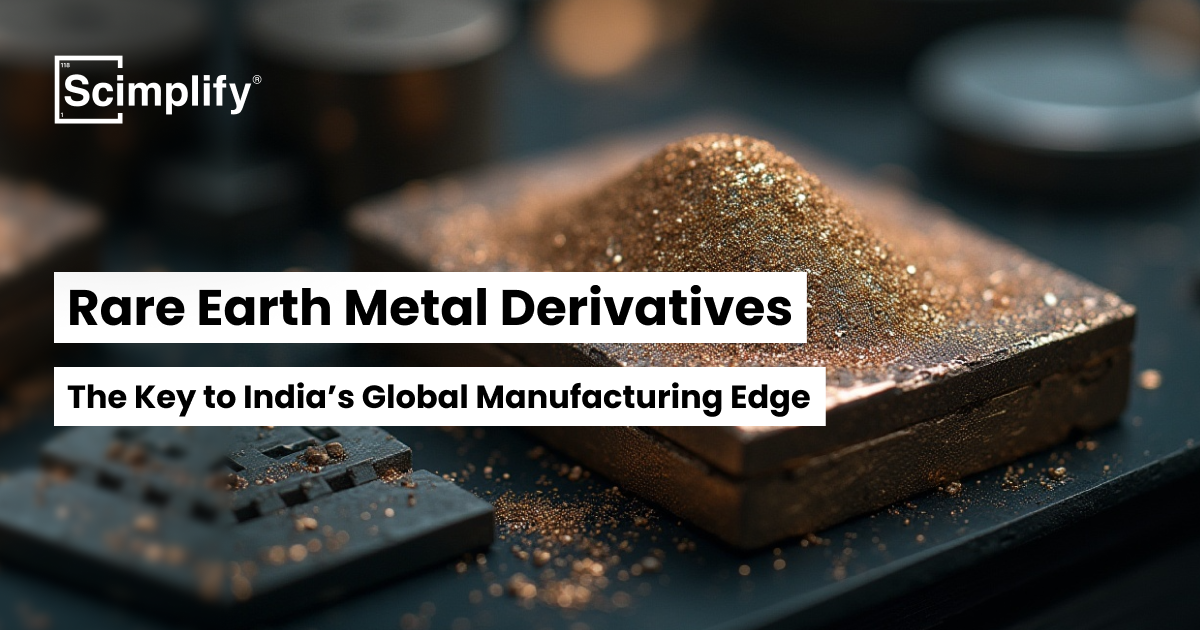
Every time you unlock your smartphone, drive an electric vehicle (EV), or use ChatGPT, you are indirectly depending on a group of elements most people would have never heard of. Rare Earth Elements (REEs) and their derivatives are like the silent architects of today’s technology.
Yet, there is a paradox looming: while these materials are called "rare," they're not actually scarce on our planet. What's rare is the “capacity” to extract, refine, and process them into usable derivatives, and that capability today is almost dangerously concentrated in just one country.
Understanding Rare Earth Metals and Their Derivatives
Rare Earth Elements: It refers to the 17 metallic elements on the periodic table (which include 15 lanthanides plus scandium and yttrium). Despite their name, they're relatively abundant on Earth's crust. In fact, cerium is more common than copper, and even the scarcest rare earth, thulium, is more plentiful than gold.
Rare Earth Derivatives: Rare Earth Elements themselves are rarely used in their pure metallic form. Instead, they're transformed into compounds, oxides, alloys, and magnets that unlock their extraordinary properties. They come in different forms, like:
- Rare Earth Oxides (REOs) form when REEs are extracted from ore and converted into their respective oxides, like Neodymium oxide (Nd₂O₃) or dysprosium oxide (Dy₂O₃).
- Neodymium-Iron-Boron (NdFeB) Magnets are the world's most powerful permanent magnets. Each modern EV requires roughly 1-2 kg of this.
- Other Rare Earth Compounds like Yttrium-aluminum-garnet (YAG) power medical and industrial lasers for precision cutting and imaging technologies.
The Global Supply Imbalance: A Geopolitical Choke Point
Just like how “oil” shaped 20th-century geopolitics with the “Middle East” controlling roughly 40% of global supply, China's grip on rare earth derivatives is far more compelling. Currently it controls over,
- 70% of global rare earth mining
- 85-90% of processing and refining capacity
- 94% of permanent magnet manufacturing
- 89% of rare earth oxide refining, among others.
You see, China doesn't just dominate the segment, but has a monopoly over the entire value chain, right from mining to refining and processing REEs. In 2024 alone, 70% of the global rare earth production was taken up by China. Even ores mined in the US, Europe, or Australia were shipped to China for processing because the technical infrastructure doesn't exist elsewhere.
How did China achieve such control?
In the 1990s and 2000s, environmental regulations tightened in the US and other Western nations, but it was China that made a strategic bet. It invested billions in building rare earth processing infrastructure and systematically undercut global competitors. By 2010, China supplied over 95% of the world's refined rare earths and continues to dominate the segment today.
Weaponizing Supply Chains
China has repeatedly demonstrated its power to use rare earths as geopolitical leverage.
1.In 2010, China stopped rare earth exports to Japan during territorial disputes, and suddenly, Japanese electronics manufacturers faced critical supply shortages.
2.In 2019, China threatened to restrict rare-earth exports amid the US-China trade war.
3.In April 2025, it specifically targeted global trade in heavy rare earth elements, which are critical for defense systems and aerospace applications, by introducing export licensing requirements.
The Global Race for Alternatives
As the world tries to reduce its dependence on China, many countries are now trying to build and rebuild their own rare earth supply chains.
United States – Rebuilding the Industry
The USA is investing heavily to rebuild its rare earth industry. The Pentagon is giving $400 million to MP Materials, its main rare earth miner. Apple Inc. signed a $500 million deal with the same company to secure a long-term supply of REEs. But the US still sends a lot of its raw material to China for processing, which shows how hard it is to rebuild the entire chain.
Australia – Leading Non-Chinese Supply Source
Australia is now the world’s strongest alternative to China. In May 2025, Lynas became the first company outside China to produce a key heavy rare earth called dysprosium oxide. Australia also has large reserves and is rapidly expanding its processing plants, so it doesn’t depend on Chinese refineries.
Myanmar – World’s Third Largest Source
Surprisingly, Myanmar, which is located along China's 1,300-mile border, has emerged as the third-largest rare earth supplier, but the catch is that it is under chaotic conditions. The United Wa State Army (UWSA), a powerful rebel militia, controls much of this production. Also, over 60% of rare earth exports from Myanmar in 2024 were undocumented, raising serious questions about environmental destruction, human rights abuses, and illegal supply chains.
India's Untapped Potential
India has nearly 6.9 million metric tons of rare earth reserves, roughly 8% of global supply. Yet in FY 2024, India produced only 2,900 metric tons of rare earth oxides, which is less than 1% of global output. India has the resources and potential, but lacks the processing infrastructure to convert them into usable derivatives.
India, however, isn’t starting from scratch. The IREL (Indian Rare Earths Limited) has been operational since 1950, giving our country 75 years of rare earth processing experience. Recognizing that raw reserves mean very little without domestic processing, the government launched the National Critical Minerals Mission (2025) with a ₹34,300 crore allocation focused heavily on building processing and separation infrastructure. New PLI incentives now support rare earth recycling and urban mining, while the KABIL (Khanij Bidesh India Limited) is out there securing international partnerships for critical minerals.
Indo-US Strategic Partnership
In February of 2025, India and the US signed the Strategic Mineral Recovery Initiative, a major agreement to jointly recover and process critical minerals, including rare earths from heavy industries. This partnership works so well because both countries need almost the same minerals; 40 of the top 50 are common and overlap.
The US brings strong technology in extraction and recycling, while India brings large reserves and growing processing capacity. Both countries are also part of the Mineral Security Partnership, which helps them team up with other nations and build safer, more reliable global supply chains.
The Path Forward – India's Strategic Drivers
1.Build and Multiply Processing Infrastructure
India’s challenge isn’t mining, it’s converting raw material into finished products. Even with large reserves, India still imports over 53,000 metric tons of rare earth magnets every year. The fix is straightforward to expand processing and magnet-making capacity. This means building new oxide, alloy, and magnet manufacturing plants beyond the existing Vizag facility.
2.Push for Recycling + Urban Mining
Old phones, wind turbines, laptops, and EV batteries are modern treasure chests. They contain rare earths that can be recovered more cheaply and with far less environmental impact than traditional mining. With the right incentives, India can build a strong ecosystem for e-waste recovery, EV battery recycling, and industrial magnet reprocessing, reducing imports and strengthening domestic supply.
3.Invest in Green Chemistry
Rare earth processing has a reputation for being dirty. India can flip this very narrative by adopting cleaner extraction technologies like ionic liquids, bioleaching microbes, and closed-loop systems. Clean refining isn’t just good for the environment; it’s a competitive advantage India can use to stand apart from competitors.
4.Foster Public-Private R&D Collab
India has brilliant scientists in labs like BARC, DMRL, and IISc who've developed rare earth processing technologies, but these innovations stay trapped in research papers and don't go beyond this phase. The planned Bhopal Theme Park aims to be a bridge, taking lab discoveries and turning them into factory-scale production. It's like taking a recipe perfected in a home kitchen and scaling it up to a restaurant chain. In the same direction, businesses and research universities must work together to turn science into viable commercial products.
India’s rare earth future will be shaped not just by what it mines, but by what it can refine, recycle, and innovate. By strengthening processing, embracing clean technologies, and uniting research with industry, India can finally unlock the full value of its mineral wealth.
Scimplify – Bridging India’s Rare Earth Future
India has the reserves and momentum to become a major rare earth player, but the real challenge lies in scaling high-purity, application-ready materials.
At Scimplify, we understand that India’s rare earth ambitions depend on one critical bridge taking breakthrough chemistry from the lab and converting it into dependable, industry-ready processes.
In our recent association with a US customer, where we enabled a partner to achieve 99 percent purity for a rare earth oxide used in EVs, wind turbines, and advanced electronics, we proved how the right scientific support can unlock new supply chain possibilities for India.
As India accelerates its rare earth journey, we are contributing through R&D partnerships, technology transfer, process optimisation, and sustainable chemistry. Our goal is to work closely with research institutions, energy companies, and advanced material manufacturers to help India refine, recycle, and innovate its way into becoming a trusted, ethical, and globally competitive supplier of critical minerals.
Write to us at info@scimplify.com to explore how we can advance your work in rare earth chemistry and critical mineral development.
