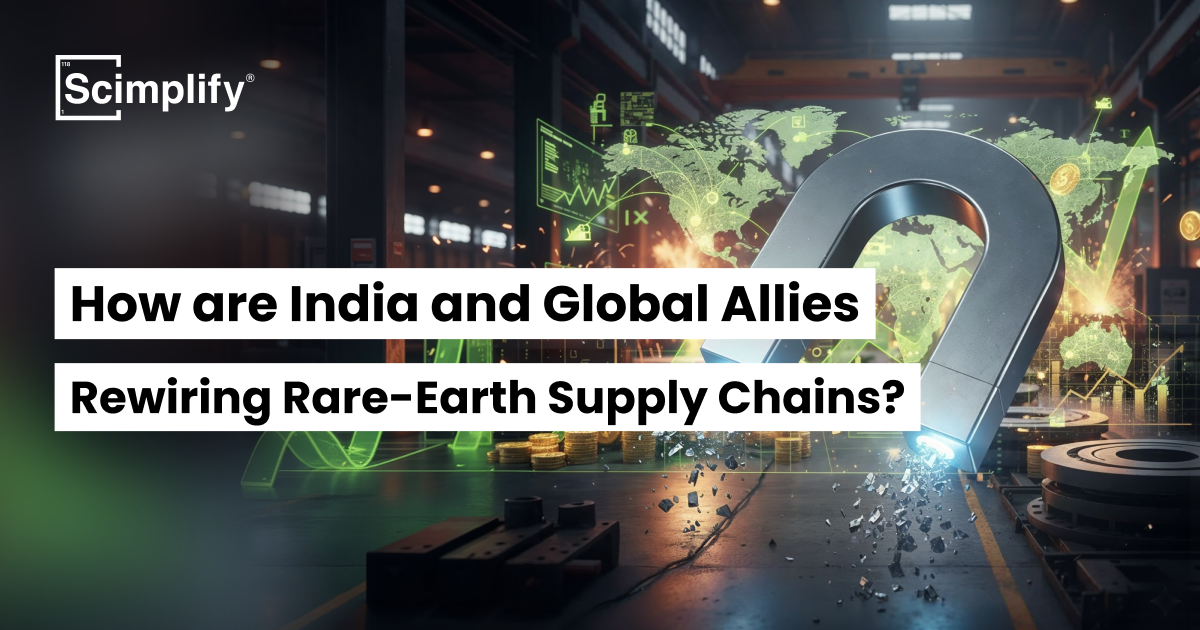
How are India and Global Allies Rewiring Rare-Earth Supply Chains?
India’s ₹7,280Cr magnet scheme, plus the US-Australia alliance and Europe’s recycling push, are reshaping critical materials manufacturing and resilience.
On November 26, 2025, India made a decision that could reshape global rare earth supply chains for the next three decades. The Union Cabinet approved the scheme to promote the manufacturing of sintered Rare Earth Permanent Magnets (REPM) with a financial outlay of ₹7,280 crore aimed at establishing 6,000 metric tons per annum of integrated rare earth permanent magnet manufacturing. This is India's first-ever end-to-end rare earth magnet manufacturing initiative, and the timing is extraordinary.
Economics Driving This Decision
Right now, India imports nearly all of its permanent magnets, primarily from China, which comes up to 4,000-5,000 tons annually, and we are spending hundreds of millions of dollars on them. Soon, India's consumption of these magnets is expected to double by 2030, driven by EV adoption and a renewable energy push. Without domestic production, India would be spending potentially $1 billion annually by 2030 on Chinese magnets while sitting on its own 6.9 million metric tons of rare earth reserves, roughly 8% of global supply.
The scheme's architecture is designed for speed and scale
- ₹6,450 crore in sales-linked incentives for REPM sales over five years
- ₹750 crore as capital subsidy for manufacturing facility setup
- Five beneficiaries selected through global competitive bidding, each allocated up to 1,200 MTPA capacity
- Seven-year duration: Two years for facility construction, five years for incentive disbursement
Why Does This Matter?
Union Minister Ashwini Vaishnaw stated that “India will become self-reliant in rare earth magnets within 3 to 4 years.” If achieved, this would be one of the fastest industrial buildouts in India's manufacturing history.
The global rare earth permanent magnet market demand stands at approximately 150,000-180,000 metric tons annually. European demand accounts for roughly 25,000-30,000 tons, yet domestic production capacity remains below 2,000 tons as of 2024. By 2030, India's 6,000 MTPA capacity would represent 3-4% of global supply – modest in absolute terms, but enormous in strategic significance.
India isn't just building factories. It's positioning itself as the democratic world's alternative to Chinese rare earth dominance. The country has 75 years of rare earth processing experience through IREL (Indian Rare Earths Limited), established in 1950. The government launched the National Critical Minerals Mission in 2025 with a ₹34,300 crore allocation focused on processing and separation infrastructure.
The $8.5 Billion US-Australia Alliance
While India builds domestic capacity, the United States has also made one of their boldest rare earth moves in its history.
On October 20, 2025, President Donald Trump and Australian Prime Minister Anthony Albanese signed the United States-Australia Framework for Securing Supply in the Mining and Processing of Critical Minerals and Rare Earths. The framework will deliver an $8.5 billion pipeline of priority projects between their two nations. The US and Australia will each invest at least $1 billion over the next six months, with total investment exceeding $3 billion in critical mineral projects within six months.
The Export-Import Bank of the U.S will issue seven letters of interest for more than $2.2 billion in financing, unlocking up to $5 billion in total investment. The Pentagon will invest in building a gallium refinery in Western Australia with a 100 metric tons per year capacity.
Europe's Rare Earth Factory and Recycling Revolution
On September 19, 2025, Europe's largest rare-earth magnet factory officially opened in Narva, Estonia, built by Canadian company Neo Performance Materials with a €75 million investment, including €14.5 million from the EU's Just Transition Fund.
The facility will produce around 2,000 metric tons of magnet blocks annually, enough to supply magnets for more than a million electric vehicles or over 1,000 offshore wind turbines. Currently employing 80 people, the plant is expected to scale to 1,000 jobs in the coming years.
The UK's CREEM consortium (CirculaREEconomy), an £11 million project led by Ionic Technologies, is recovering magnets from end-of-life EVs and electronics with participants including Ford, Bentley, Wrightbus, and metal recycler EMR. In Italy, startup RarEarth raised €2.6 million to build the country's first NdFeB magnet factory from recycled e-motor waste.
The Geopolitical Endgame - Trust Winning Over Cost
What we're witnessing is a fundamental reordering of global supply chains based on a principle that would have seemed naive five years ago - trust matters more than cost.
For decades, globalization operated on pure economics to make it where it's cheapest. The result was concentrated, fragile supply chains vulnerable to disruption. In 2020, COVID-19 exposed the pharmaceutical supply chain vulnerability. The Ukraine war exposed energy dependence. And all in all, China's rare earth dominance exposes the critical materials chokepoint. The new paradigm prioritizes resilience, transparency, and political alignment alongside cost. Companies are willing to pay premiums for a secure supply. Governments are providing massive subsidies to rebuild domestic capabilities. Allies are pooling resources and sharing risks.
The Path Forward
China will remain a giant in the rare earth industry. It has decades of experience and deep technical expertise. However, the world is no longer standing still.
India is stepping forward with a strong domestic mission. The United States is rebuilding its ecosystem. Australia, Canada, and Brazil are becoming key miners. Europe is using legislation and investment to accelerate capacity. The result is a more resilient and distributed rare earth network.
If countries continue to align on responsible mining, clean processing technologies, and balanced supply chains, the rare earth sector can become stronger, greener, and more stable. The world is not moving away from China immediately. But it is moving toward choice, redundancy, and shared capability.
Scaling India’s Rare-Earth Ambition with Scimplify
As global allies diversify and rebuild rare-earth supply chains, India is emerging as a key force in this transformation.
While countries like the United States, Australia, Japan, and regions across Europe expand their mining, refining, and recycling capabilities, India brings a unique combination of vast reserves, strong policy momentum, and a national mission to build world-class rare-earth manufacturing at scale.
The real challenge now is not just owning resources, but converting them into high-purity, application-ready materials that meet the demanding requirements of EVs, wind turbines, electronics, and next-generation technologies – a space where advanced chemistry, smart process design, and scalable manufacturing must work together.
At Scimplify, we believe India can become a trusted rare-earth leader by combining these natural advantages with deep scientific capability. Our work already reflects this potential. In a recent collaboration with a US customer, we helped a partner achieve 99 percent purity for a rare-earth oxide used in high-performance clean energy and mobility applications – demonstrating that India can reliably deliver materials that meet global quality benchmarks.
As India accelerates its rare-earth ambitions alongside global allies, Scimplify supports this shift by providing:
- Advanced R&D and technology transfer to enable scalable, industrial-ready processes
- Process optimisation to improve purity, yield, and sustainability
- Green chemistry approaches that minimise waste and environmental impact
Write to us at info@scimplify.com to explore how Scimplify can accelerate your rare-earth chemistry, process development, and critical-mineral innovation from lab to market with precision, compliance, and scalable execution.
