Reimagining a Zero-Waste Future with Circular Chemistry
Discover how Circular Chemistry is transforming India’s chemical industry through waste-to-value innovation, sustainable processes, and Scimplify’s circular sourcing solutions.
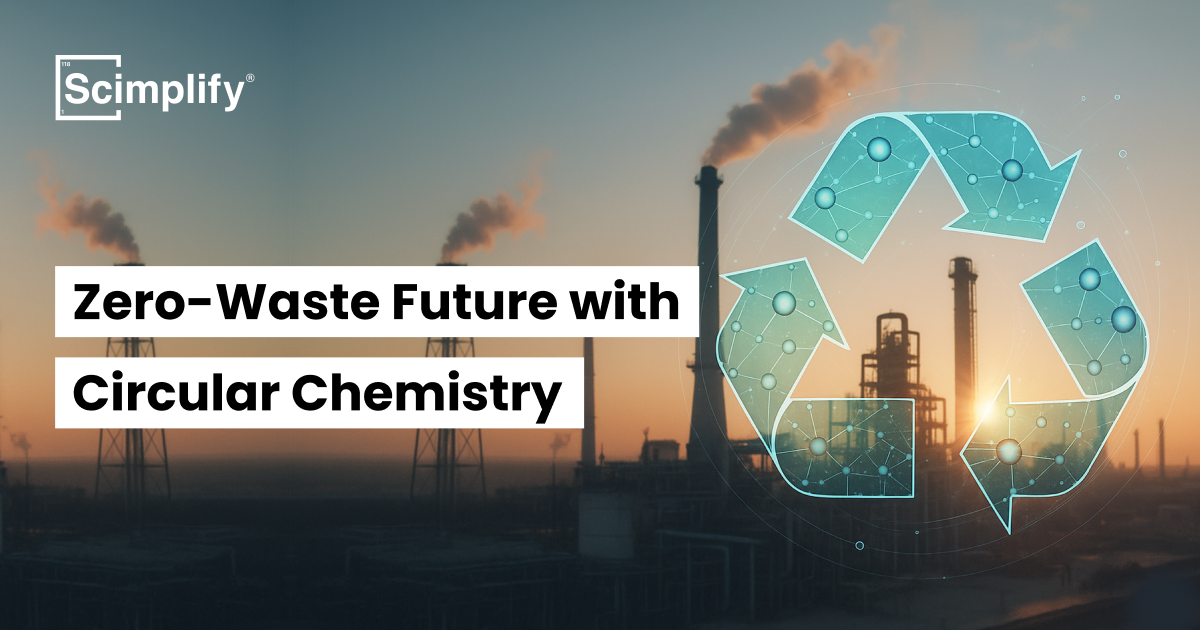
Extract, manufacture, use, discard. This linear model has been a staple of the chemical industry for decades. While this model has delivered scale, it has depleted resources, harmed the environment, and eventually pushed manufacturers to rethink how materials move through the economy.
Today, with global supply chains strained and sustainability fast becoming a business mandate, the sector finds itself at an inflection point - Circular Chemistry (CC).
Hailed as the next big shift, Circular Chemistry redefines how chemicals are designed, produced, used, and reused. More than a sustainability trend, CC is becoming the new operating system for the industry. It closes material loops, reduces dependency on virgin resources, and builds the foundation for a zero-waste chemical economy.
What Circular Chemistry Really Means?
Circular Chemistry treats molecules as assets that must circulate, not be lost, discharged, or discarded. It involves reshaping processes to recover value repeatedly.
Why Circular Chemistry, and Why Now?
Beyond the environmental and health hazards, the linear economic model is now collapsing under the sheer scale of global waste generation.
Global Municipal Solid Waste (MSW) is projected to rise from 2.1 billion tonnes in 2023 to 3.8 billion tonnes by 2050, while industrial hazardous waste in India continues to grow 2%–5% annually, and global waste-management costs are on track to nearly double from USD 252 billion to USD 640.3 billion if urgent action is not taken.
How Does Circular Chemistry Help?
Here, circularity steps in as a strategic lever for competitiveness, cost security, and compliance. Instead of constant extraction, this type of economy relies on reducing, reusing, repairing, and recycling materials. The Zero-Waste Goal complements this by ensuring every product is designed to return value, whether in nature or in the marketplace, rather than ending up in a landfill.
Think of the economy mirroring nature’s operating system. Nothing is wasted, and everything cycles. Circular Chemistry applies this principle to chemicals, materials, and industrial processes, thereby moving away from the disposable model and toward regeneration.
At the core of CC are principles such as:
Maximizing atom utilization: This principle ensures that every atom in every molecule is used, recovered, or regenerated. A nitration process adopted by Aarti Industries is an example of this principle. Here, a process-intensification study enabled the conversion of nitric-contaminated spent acid into nitric-free, reusable acid. The recovered acid now fully replaces virgin input, improving resource efficiency and cutting the product’s carbon footprint by 4%.
Designing out toxicity: Here, processes and products are created with the goal of zero harmful emissions across the lifecycle. This begins at the design stage, right from selecting safer materials, solvents, and reaction pathways, so pollutants never form in the first place.
A clear example is Merck’s enzyme-based synthesis of sitagliptin, which replaces metal catalysts and hazardous reagents with a biocatalytic route, dramatically reducing toxic by-products and improving worker and environmental safety. It reflects how circular design shifts the industry from pollution control to pollution prevention.
Building energy-persistent systems: Here, energy efficiency is optimized, and wasteful steps are minimized. The chemical industry is energy-heavy, and cutting this demand is crucial for climate goals. Companies do this by removing unnecessary energy steps, using waste heat recovery systems that eliminate the requirement for fresh energy, and shifting to renewables.
Making catalysis the backbone: Since most chemical reactions rely on catalysts, regenerating and reusing them becomes core to circularity. Platinum-group metals are, especially, too precious and costly to waste. Companies like Hindustan Platinum are studying how smarter catalysis can reduce waste, lower costs, and keep valuable materials in the loop.
Shifting from product sales to service models: Selling performance instead of consumption, as waste becomes inefficient, not inevitable. This principle is best exemplified in Product-as-a-Service models, chemical leasing, and repair-and-return systems that keep assets in circulation longer.
Together, these principles align with global sustainability goals and push industries toward safer, cleaner, and more resource-efficient growth.
India’s Context: Waste Streams, Policy Momentum & Market Opportunity
India is uniquely positioned to lead the transition to Circular Chemistry. The country’s industrial growth, abundant waste streams, and evolving environmental policies all point in the same direction: the linear model is no longer sufficient, and circularity is both an economic opportunity and a competitive necessity.
Government Push Is Fast-Tracking Circular Economy Transition with Policy, PLI & Industry Investment
India’s Circular Economy transition is accelerating, driven by NITI Aayog’s 11 national focus areas and the Department for Chemicals and Petrochemicals’ leadership on toxic and hazardous industrial waste. The government’s INR 1.97 lakh crore PLI push is directly funding waste-to-value and green-chemistry innovation, positioning the CE market to reach USD 2 trillion by 2050.
Startups and New Entrants Set to Benefit
Startups and established companies adopting Circular Chemistry benefit from input costs lowered by 30%-50%, higher stability in raw materials, traceability requirements from global buyers, and alignment with ESG expectations.
Circular Products in India
Circular Chemistry is easiest to understand when you see it in motion, not as a policy or a principle, but as a transformation happening across India’s waste streams. The best way to do so is to follow the journey of waste as it travels back into the marketplace.
Reliance’s CircuRepol™ & CircuRelene™ Recycle Plastic Waste into Circular Polymers
It begins with plastics. Over 3.5 million tonnes of plastic waste are generated every year in India, making it one of the country’s most urgent and visible waste streams. This plastic, including HDPE, PET, and PVC, is now becoming a high-value circular feedstock, moving from landfills into chemical recycling loops, best exemplified by CircuRepol™ (Polypropylene) and CircuRelene™ (Polyethylene).
These ISCC-Plus certified Circular Polymers are generated from plastic waste-based pyrolysis oil via chemical recycling, a feat by Reliance Industries Limited.
Tata Salt’s Shift to PE-PE Recyclable Laminates Replaces Multi-Layer Packaging
Flexible packaging remains one of the most challenging segments in India’s waste landscape, primarily because multi-layer laminates combine several incompatible polymers that cannot be mechanically recycled. As a result, they typically move straight to landfills.
Its circular alternative is emerging through recyclable PE-PE laminates. These single-polymer structures are engineered to replace conventional multi-layer films. A notable example is Tata Salt, which has transitioned to PE-PE laminate for its consumer packs and reached 143 million households across India.
By standardising the structure to a single polymer, the material becomes significantly easier to recover and process. PE-PE laminates can be routed into energy-recovery or chemical-recycling pathways, including combustion, gasification, and pyrolysis. These routes convert the material into usable outputs such as syngas, oil fractions, or energy, thereby reintegrating it into industrial value chains rather than losing it to disposal.
CC-Led Circular Pathways Turn Used Cooking Oil into Biodiesel & Biopolymers
The narrative continues in kitchens across India. Used cooking oil, which once had no formal end-of-life path, is today one of the most reliable circular feedstocks. Through CC-led processes, UCO transforms into biodiesel, biolubricants, and specialty biopolymers, feeding supply chains that were previously dependent on petroleum.
Tata Chemicals’ Agro-Residue Valorisation & UPL’s Crop-Residue–Based Formulations
Agricultural fields tell a similar story. Rallis India Limited is extracting value from agro-residues such as bagasse and corn stover to produce bio-based ingredients like nutraceutical-grade fructooligosaccharides and organic acids. These bio-based molecules support booming sectors like packaging, nutraceuticals, and specialty chemicals. UPL is integrating crop-residue derivatives into sustainable formulations and biochemicals, reducing reliance on petroleum-derived intermediates.
Acids, Metals & Solvents Re-Entering Production Cycles
Even waste that industries once struggled to dispose of, such as sludge, spent solvents, and catalyst residues, now has a renewed purpose. With advanced recovery technologies, companies extract acids, salts, metals, and high-purity solvents from these streams, feeding them back into their own production cycles. Materials that once posed disposal challenges now offset raw material costs.
City-Scale Circularity: Converting Organic MSW into Ethanol, Methanol & Green Solvents
And in cities, organic fractions of municipal solid waste are being turned into ethanol, methanol, and green solvents, creating industrial feedstock from daily household discards.
Across this landscape, Circular Chemistry acts as the guiding force that converts linear dead-ends into regenerative loops, turning “waste” into a continuous source of industrial value.
A Broader Industry Movement Taking Shape
Beyond these flagship examples, a wider shift is visible across India’s chemical and manufacturing landscape. Aarti Industries is recovering high-purity solvents, acids, and specialty intermediates through closed-loop ZLD systems for internal reuse. Atul Ltd. is implementing circular recovery of catalysts, spent solvent streams, and by-products to strengthen resource security across its value chains. Meanwhile, public-sector leaders like Indian Oil Corporation (IOCL) are scaling plastic-to-chemicals facilities and demonstrating how municipal plastic waste can re-enter petrochemical feedstock cycles.
Barriers Still Exist
India’s transition isn’t without the challenges of high capital expenditure, decentralized waste collection, variable waste quality, lack of supply-chain transparency, and a shortage of skilled talent. But these gaps are solvable, and many companies are already proving that early adoption generates long-term advantage.
Scimplify’s Role in the Circular Chemistry Revolution
Circular Chemistry offers a more intelligent way to source materials, reduce supply volatility, enhance ESG performance, and build long-term industrial resilience. India has the feedstocks, the policy push, and a rapidly maturing ecosystem, putting the country in a strong position to lead the global circular transition.
At Scimplify, we see this shift not as a distant trend but as an urgent, structural transformation already underway. We are taking early steps to accelerate circular supply chains by:
- Helping companies discover and evaluate waste-derived intermediates as viable alternatives to conventional raw materials.
- Connecting manufacturers with pre-vetted sustainable suppliers, enabling procurement teams to source more responsibly and confidently.
- Bringing greater transparency into chemical sourcing, starting with data-backed insights on traceability, feedstock origin, and environmental impact.
These are the foundations of a more regenerative industrial system - one where waste becomes a resource, and circularity becomes standard practice.
For manufacturers ready to compete in a future where resource efficiency determines advantage, the time to build circular supply chains is now, and Scimplify is here to help make that transition both practical and profitable.
Write to us at info@scimplify.com to explore how Scimplify can help you accelerate circular chemistry through sustainable sourcing, waste-to-value solutions, and traceable, future-ready supply chains.
